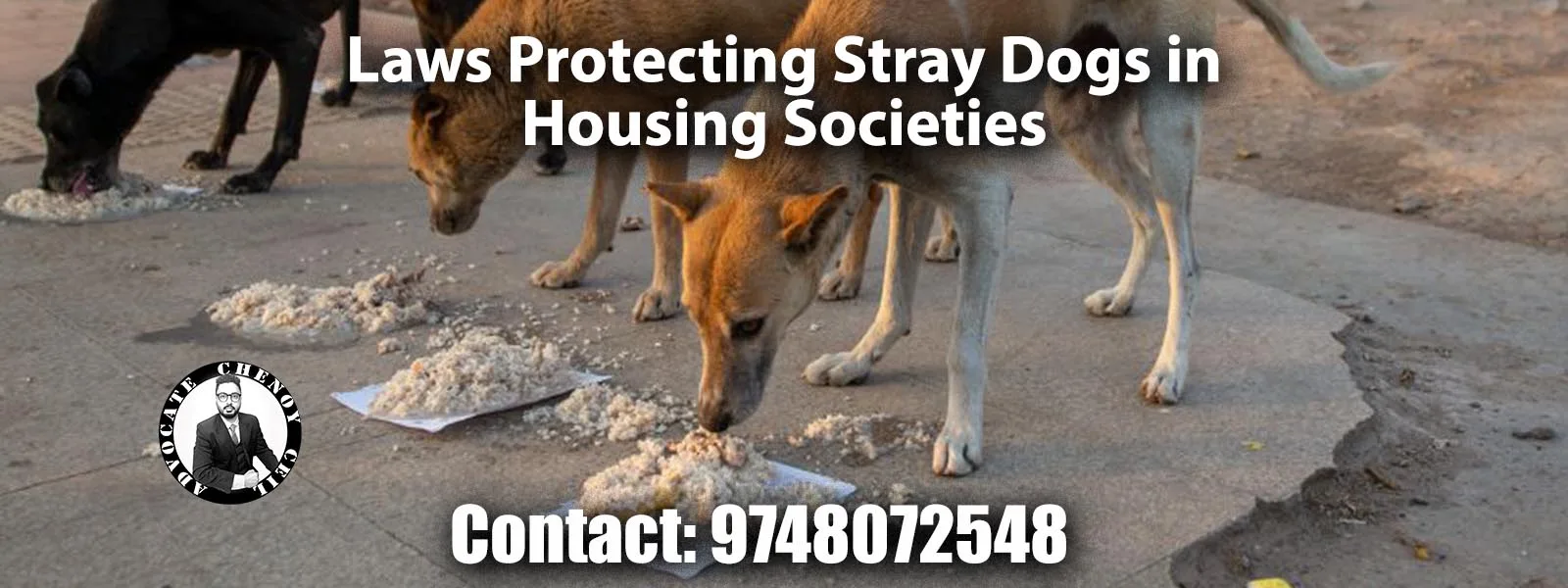
Laws protecting stray dogs in housing societies are crucial for a more humane society and for reducing conflicts among the residents.
Table of Contents
Stray Dogs in Housing Societies
In recent years, the management and welfare of stray dogs in residential complexes and gated communities across Kolkata have drawn significant legal scrutiny. While Resident Welfare Associations (RWAs) and Apartment Owners Associations (AOAs) strive to maintain security, animal lovers and feeders advocate for the fundamental rights of street canines.
In a series of landmark judgments, the Supreme Court of India and various High Courts have established a strictly regulated legal framework. The law confirms that stray dogs have an inherent right to live without cruelty, but it heavily mandates regulated feeding in designated zones to balance human safety with animal welfare.
Key Legal Frameworks Protecting Stray Dogs
1. Animal Birth Control (ABC) Rules, 2023
Rooted in the parent statute, The Prevention of Cruelty to Animals Act, 1960, the ABC Rules, 2023, are the primary binding regulation for stray dog management in India.
- Prohibition of Relocation: It is illegal for an RWA, AOA, or local authority to relocate, displace, or remove stray dogs from their natural territory.
- Sterilisation and Vaccination: The law strictly defines Catch-Sterilise-Vaccinate-Release (CSVR) as the only lawful mechanism to manage the street dog population. Once vaccinated and immunised, dogs must be returned to the exact location from which they were captured.
- Mandatory Feeding Spots: Under these rules, RWAs and AOAs are legally obligated to provide designated, fixed feeding spots within or just outside the society premises.
2. The Indian Penal Code (IPC) & Bharatiya Nyaya Sanhita (BNS), 2023
Cruelty to animals, including starving, poisoning, beating, or deliberately injuring stray dogs, constitutes a cognisable criminal offence.
- Under Section 11 of the Prevention of Cruelty to Animals Act, 1960, and relevant provisions of the Bharatiya Nyaya Sanhita (BNS), 2023 (which replaced the IPC), individuals or RWA members resorting to violence against animals face fines and imprisonment.
Landmark Case Laws and Judicial Precedents (Updated 2026)
The judiciary has significantly updated the interpretation of animal rights versus public safety. The absolute right to feed stray dogs anywhere has been restricted, and accountability has been redefined:
1. The Definitive Supreme Court Verdict: In Re: “City Hounded by Strays, Kids Pay Price” (May 2026)
In a major milestone judgment, a three-judge bench of the Supreme Court comprising Justices Vikram Nath, Sandeep Mehta, and N.V. Anjaria dismissed all pending challenges regarding stray dog management. The apex court laid down critical national directives:
- Constitutional Balance (Article 21 vs Animal Welfare): The Supreme Court held that while the legal framework mandates compassion, the right to life and free movement under Article 21 of the Constitution tilts the balance in favour of human safety. Citizens, especially children and the elderly, cannot be left vulnerable to aggressive or rabid packs.
- Strict Ban on Open Street Feeding: The apex court explicitly banned the open, unregulated feeding of stray dogs on public streets and non-designated areas. Feeding is strictly restricted to designated zones mapped out by municipal bodies and RWAs.
- Euthanasia for Aggressive Dogs Permitted: For the first time, the court clarified that municipal and local authorities are legally permitted to adopt measures including euthanasia for rabid, incurably ill, or demonstrably dangerous and aggressive dogs, adhering strictly to the procedures under the ABC Rules, 2023.
- High Court Surveillance: The Supreme Court directed all High Courts across India (including the Calcutta High Court) to initiate suo motu proceedings to monitor day-to-day compliance by municipal corporations, ensuring infrastructure like ABC Centres are built.
2. Strict Liability on Feeders & States (Supreme Court, January 2026)
During the progression of the same suo motu case, the Supreme Court warned of imposing heavy financial compensation on State Governments and municipal bodies for failing to control the stray population via proper ABC infrastructure. Crucially for housing societies, the Bench mooted tortious liability on dog feeders, observing that if a person feeds aggressive dogs in non-designated zones and an injury or fatality occurs, the feeder can be held personally and financially accountable for the damages.
3. High Court Restriction on Entry/Exit Point Feeding: Ayyappa Swami v. State of Maharashtra (Bombay HC, December 2025)
Interpreting Section 126 of the Bharatiya Nyaya Sanhita (BNS), 2023 (Wrongful Restraint), the High Court ruled that stopping someone from feeding stray dogs near housing society entry/exit points, footpaths, or school bus stops is a lawful child-safety measure.
The court quashed criminal proceedings against a resident who objected to unregulated feeding, ruling that objection in good faith for the safety of children does not constitute an offence. The court emphasised that housing society residents are entirely justified in demanding that feeding be moved strictly to designated, low-footfall areas.
Responsibilities and Guidelines for Kolkata Housing Societies
To prevent legal disputes and comply with the directives of the Supreme Court, the Kolkata Municipal Corporation (KMC) and RWAs must implement the following harmonised guidelines:
- Map Out Designated Feeding Zones: The RWA/AOA must sit down with local animal feeders to identify specific, low-footfall areas within or around the society complex. These zones must not be near children’s parks, lifts, staircases, school bus pick-up points, or main entry/exit gates.
- Adhere to Specific Timings: Feeding times should be mutually agreed upon (e.g., early mornings or late nights) when the movement of residents, delivery personnel, and children is minimal.
- Form an Animal Welfare Committee: In case of persistent friction between animal lovers and residents, societies must form a 7-member Animal Welfare Committee comprising RWA members, local feeders, and a KMC veterinary representative to mediate conflicts internally.
- Partner with KMC for Sterilisation: Gated communities in Kolkata should proactively coordinate with the Kolkata Municipal Corporation (KMC) or registered animal welfare NGOs to ensure 100% vaccination and sterilisation of the resident stray dogs. Tagged and sterilised dogs are significantly less aggressive.
Conclusion
As of 2026, the law does not permit the banishing or starving of stray dogs in Kolkata’s housing societies. However, it severely reprimands unregulated feeding that compromises human safety. RWAs cannot forcefully remove dogs, but they possess the legal right to enforce strict boundaries on where and when those dogs are fed. A collaborative approach between compassionate feeders and safety-conscious management is the only legally compliant path forward.
For any help regarding disputes arising out of pets in housing societies, do contact us.