Table of Contents
Registering a Society or Non-Governmental Organisation (NGO) in West Bengal is a significant step toward gaining legal recognition for social welfare, cultural, literary, or charitable initiatives. In West Bengal, this process is strictly governed by the West Bengal Societies Registration Act, 1961 (WBSRA, 1961).
With the Government of West Bengal fully digitising the infrastructure through the West Bengal e-District Portal, establishing a society has become increasingly seamless. However, minor regulatory errors or misinterpretations of structural compliance can lead to an outright rejection by the Registrar.
This comprehensive guide outlines the complete step-by-step registration process for 2026, required documentation, updated fees, and vital judicial precedents from the High Court and Supreme Court that you must know before applying.
What is a Society under the West Bengal Act of 1961?
Under Section 4(1) of the West Bengal Societies Registration Act, 1961, any seven or more individuals who are associated for a common, non-profit objective can subscribe their names to a Memorandum of Association (MoA) and file it with the Registrar of Firms, Societies and Non-Trading Corporations, West Bengal to form a registered society.
Permissible Objects for Society Registration [Section 4(2)]
A society can only be registered if its primary objectives align with the categories specified under Section 4(2) of the Act, which include:
- Promotion of literature, science, arts, or education.
- Diffusion of useful knowledge or political education.
- Charitable purposes, including the relief of orphans, the aged, sick, helpless, or indigent persons.
- Promotion of sports and culture.
- Environmental conservation and social welfare.
Step-by-Step Online Registration Process via West Bengal e-District
Physical, over-the-counter submissions have been completely replaced by online workflows. To register a society in Kolkata or any other district in West Bengal, follow this digital roadmap:
Step 1: Account Creation on e-District
- Visit the official West Bengal e-District Portal (
https://edistrict.wb.gov.in/). - Register as a new user to generate your unique User ID and Password.
Step 2: Name Availability and Approvals
- Log in, navigate to the “Department” column, and select Registration of Societies.
- Enter your proposed name. Ensure the name does not closely resemble or match any existing registered society, or conflict with protected state emblems (Section 7 of WBSRA).
Step 3: Filling out the Digital Application Form
You must complete the digital application fields precisely. The form requires:
- Basic details of the Applicant (President or Secretary).
- Signatories to the Memorandum: You must enter the exact names, occupations, and addresses of a minimum of 7 members.
- Designations within the Governing Body (e.g., President, Vice-President, Secretary, Treasurer).
Step 4: Uploading Mandatory Supporting Documents
Scan and upload the following documents (Self-attested and clear):
- Standard Memorandum of Association (MoA) and Regulations (Bye-laws): Signed on each page by the President and the Secretary.
- Identity & Address Proofs: Aadhaar Cards, PAN Cards, or Voter IDs of all 7+ founding signatories. Note: Signatories’ Aadhaar must be linked to active mobile numbers for OTP verification.
- Passport-Sized Photographs: Clear colour photographs of all signatories with names mentioned below.
- Registered Office Proof: Geo-tagged colour image of the society’s registered office building.
- Land Ownership Documents: Latest Municipal/Corporation tax receipt or Land records (from Banglarbhumi) of the property.
- No Objection Certificate (NOC): A notarised NOC from the landowner explicitly permitting the society to operate from the premises.
- Witness Identification: Self-attested Aadhaar Card of an independent witness.
Step 5: Verification and Fee Payment
- Once submitted, the application lands with the Dealing Assistant for document verification.
- If deficiencies are found, it will be returned to your portal dashboard for corrections.
- Upon validation, the Registrar approves the application for payment. The flat registration fee under the WBSRA is ₹150.00, payable online through the integrated GRIPS payment gateway.
Step 6: Digital Signature and Downloading the Certificate
Following successful payment, the application goes through final approval. The Registrar signs the generated PDF with a secure digital signature. You can track the status online and download your official Certificate of Society Registration directly from the portal. The entire statutory process takes up to 30 days as per the West Bengal Right to Public Services (WBRTPS) Act timelines.
Landmark Case Laws & Judicial Precedents (Updated for 2026)
Understanding statutory text is not enough; one must look at how the judiciary interprets the West Bengal Societies Registration Act, 1961. Below are essential judgments that guide society operations, maintainability of suits, and registration hurdles:
1. Maintainability of Legal Suits by a Society
- Case Law Reference: Council of West Bengal Handicapped and Social Welfare v. State of West Bengal & Ors.
- Legal Principle: Under Section 19 of the West Bengal Societies Registration Act, 1961, a society can sue or be sued only in the name of the President, Secretary, or any other office-bearer explicitly authorised by the Governing Body. The Calcutta High Court observed that a lawsuit filed purely in the name of the society without a specific authorizing resolution and verification by a legally competent officer is technically defective and liable to be dismissed at the threshold.
2. Statutory Remedy Against Rejection of Registration
- Case Law Reference: Alak Jari Saren v. The State of West Bengal & Ors.
- Legal Principle: When the Registrar of Firms, Societies, and Non-Trading Corporations refuses to grant a registration certificate under Section 7, applicants often file writ petitions directly in the High Court. However, the High Court emphasized that under Section 7(3) of the Act, an explicit alternative statutory remedy is available. Aggrieved parties must approach the State Government via an executive appeal rather than rushing to invoke writ jurisdictions, ensuring administrative channels are exhausted first.
3. Structural Validity of Amended Rules and Bye-laws
- Case Law Reference: Sanjay Budhia Family Trust & Ors. v. Tripura Enclave Residents’ Welfare Association & Ors.
- Legal Principle: This ruling clarifies the strict application of Section 9(1) of the WBSRA. If a registered society amends its internal regulations or bye-laws, those modifications do not legally come into force until a certified copy has been filed and accepted by the Registrar. Abandoning old rules or functioning under unfiled amendments is legally invalid and unenforceable.
4. Commercial/Regulatory Interferences
- Case Law Reference: Khejuri Bus Owners Association and Anr. v. The State of West Bengal and Ors. (2024)
- Legal Principle: The Calcutta High Court re-examined the scope of operational powers enjoyed by trade-based societies registered under the Act. While a society can protect the collective interests of its members, it cannot bypass state-appointed regulatory authorities (like regional transport authorities or local administrations) to self-regulate commercial operations, emphasizing that a society’s internal bye-laws remain subordinate to state statutes.
Crucial Statutory Rules: Avoid These Mistakes
- No Minor Membership: Under the West Bengal rules, all founding members and subscribers must be above 18 years of age. A single minor signature will invalidate the entire MoA.
- Property Disputes: The land selected for the registered office must have a clear title and be free from active litigation. In panchayat areas, ensure that the land classification on the Banglarbhumi record is accepted (such as Bastu, Shali, or Danga).
- The Apartment Association Misconception: Crucial Note for 2026: Residential apartment complexes looking to manage maintenance, common areas, and collections cannot register under the WBSRA, 1961. The appropriate framework for flat owners is the West Bengal Apartment Ownership Act, 1972. Societies registered under the 1961 Act lack the statutory teeth to legally enforce maintenance collections or claim legal ownership of common areas, a point repeatedly upheld by real estate regulatory bodies and state courts.
Conclusion
Registering your society in West Bengal provides your NGO or welfare group with a distinct legal identity, the ability to open corporate bank accounts, eligibility for government grants, and tax-exemption paths under the Income Tax Act.
Given the strict digital validation checks on the e-District portal and the legally binding nature of the Memorandum of Association, it is highly advisable to draft your bye-laws meticulously and double-check all land and identity documentation before submission.
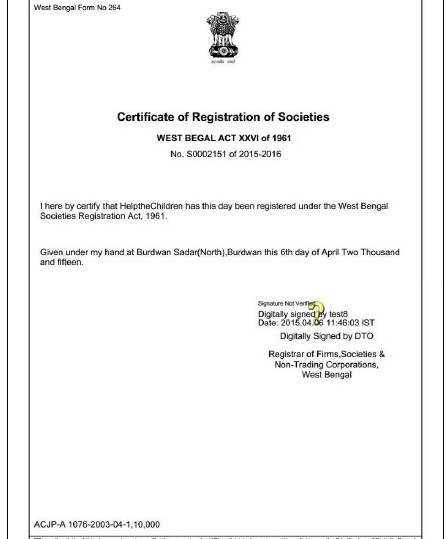
Certificate of Registration of Societies:
For more help, contact us.
In the document mentioned I think completion certificate and sanctioned plan of the housing complex is necessary. But , is it necessary to sign these documents by owners representative?
It is better to get them self attested