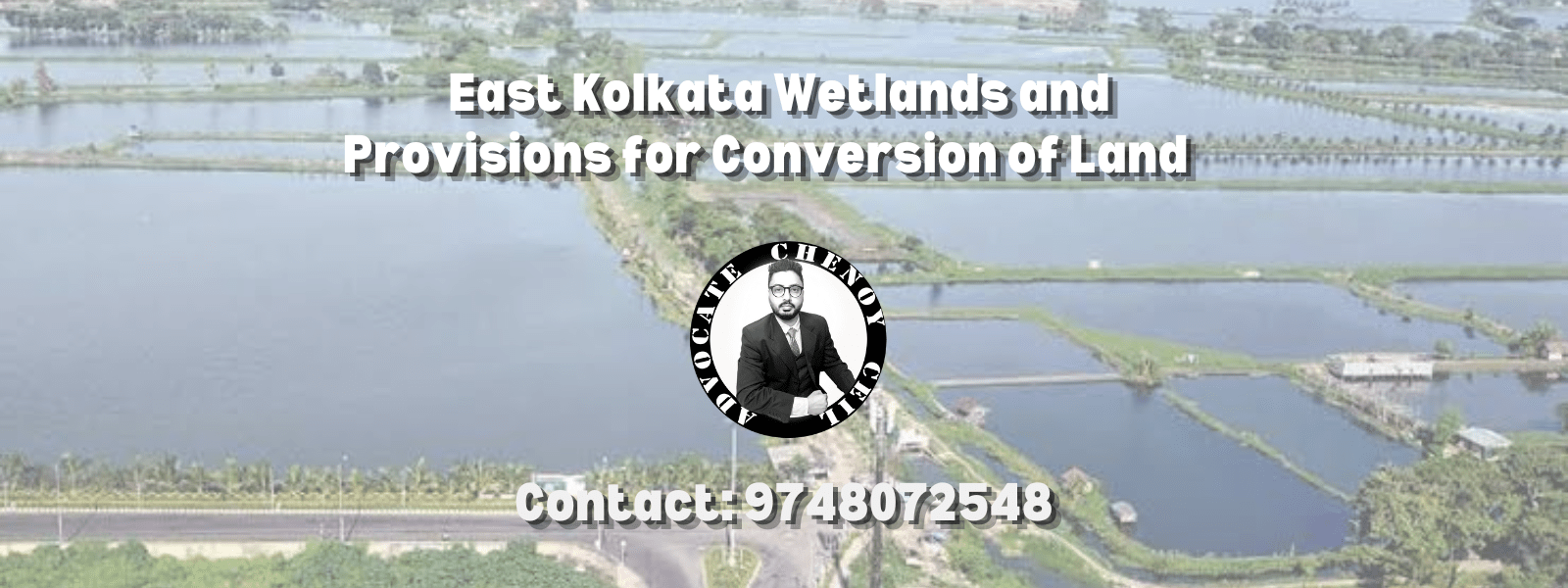
East Kolkata Wetlands and provision for conversion of land is an important aspect to understand how wetlands are governed within West Bengal.
Table of Contents
Wetlands in West Bengal, particularly the globally celebrated East Kolkata Wetlands (EKW), represent critical eco-spaces that demand the most stringent conservation measures. Encompassed by The East Kolkata Wetlands (Conservation and Management) Act, 2006, these statutory frameworks ensure the absolute preservation of wetland extents and severely restrict unauthorized repurposing or filling of land.
For property owners, developers, and pisciculture stakeholders, understanding the exact legal procedures for land character changes is vital. With heightened judicial surveillance by the National Green Tribunal (NGT) and the Calcutta High Court in 2026, navigating land conversions requires strict compliance with state legislation and environmental mandates.
What are the East Kolkata Wetlands?
The East Kolkata Wetlands (EKW) are a complex network of natural and man-made wetlands located on the eastern fringes of Kolkata, spanning over 12,500 hectares. Spreading across the districts of North and South 24 Parganas and covering 37 Mouzas, it hosts the world’s largest wastewater-fed aquaculture system.
Designated as a Ramsar Site of International Importance in August 2002, the EKW serves as Kolkata’s natural sewage treatment plant, ecological carbon sink, and primary flood defence mechanism.
The East Kolkata Wetlands (Conservation and Management) Act, 2006
To curb aggressive urban encroachment driven by peri-urban corridors like Rajarhat-New Town and the EM Bypass, the state enacted The East Kolkata Wetlands (Conservation and Management) Act, 2006.
Key Statutory Provisions:
- Section 4: Establishes the East Kolkata Wetlands Management Authority (EKWMA). Reconstituted as a powerful 13-member body under the chairmanship of the Minister-in-Charge, Department of Environment, Government of West Bengal, it regulates all activities within the demarcated boundaries.
- Section 9 (Mandaroty Maintenance): Explicitly mandates that every person holding land within the EKW boundary must maintain and preserve the land in its original character.
- Ban on Unauthorised Conversions: No person can change the use, fill up, or alter the character of any water body or low-lying land within the notified area without explicit prior sanction from the EKWMA.
East Kolkata Wetlands (Conservation and Management) Rules, 2006
The procedural aspects of enforcement are laid out under the corresponding Rules of 2006, read alongside the Central Government’s Wetlands (Conservation and Management) Rules, 2017. These rules define the boundary coordinates, categorise the land use zones (settlement, agricultural, and water bodies), and outline strict penal consequences for unauthorized alterations.
Ground Realities and Judicial Directives (2026 Update)
The year 2026 marks a pivotal period for the EKW. Driven by the concluding phases of the East Kolkata Wetlands Management Action Plan (2021–2026), the state has clamped down strictly on unauthorised encroachments.
- Strict Judicial Enforcement: In recent directives (such as Ranjit Kumar Sapui vs State of West Bengal & Ors. before the NGT Eastern Zone Bench), the judiciary has directed the EKWMA to aggressively clear illegal structures, debris, and commercial godowns, ordering the physical restoration of filled lands back into water bodies.
- The “Pre-2006” Boundary Rule: The EKWMA maintains that any structure erected within the notified wetlands zone after the enforcement of the 2006 Act is entirely illegal. Legal actions are being executed without exception, and unchecked structures lack any provision for retrospective regularisation.
Legal Provisions for Conversion of Wetland Land
While the overarching statutory objective is absolute preservation, the law does accommodate exceptional circumstances under a highly regulated window. Section 9 allows an owner to apply for a change of land character only if it serves public interest or enhances the local environment without disturbing the ecological balance.
Inter-Statutory Coordination:
Any conversion approved by the EKWMA must align seamlessly with Section 4C of the West Bengal Land Reforms Act, 1955. The EKWMA acts as the initial vetting authority, which then recommends the case to the District Collector or Land Reforms officials for final mutation.
Furthermore, under the West Bengal Inland Fisheries Act, any permitted filling up of a water body carries a mandatory legal obligation to create a Compensatory Water Body of equal or greater size in a contiguous location to preserve the regional hydrology.
Step-by-Step Procedure for Seeking Land Character Alteration
If a landholder inside the EKW layout intends to legitimately alter the mode of use for environment-improving or permissible utility projects, the following statutory steps apply:
- Submission of Application: The applicant must submit an application to the EKWMA using Form 1 in triplicate, accompanied by the prescribed processing fees.
- Scrutiny and Field Survey: The Authority scrutinises the title, coordinates, and layout. An expert technical committee is routinely deployed to conduct physical inspections to ensure the requested alteration will not disrupt wastewater passage or local biodiversity.
- The Hearing Stage: The applicant is granted an opportunity to present the environmental or public utility merits of the project.
- Referral to the Collector: If satisfied, the EKWMA forwards the specific clearance to the District Collector for passing formal orders under Section 4C of the West Bengal Land Reforms Act, 1955.
Landmark Judicial Stance on Conservation
The legal precedent governing the East Kolkata Wetlands is rooted in the historic 1992 Calcutta High Court ruling (People’s Green Culture vs. State of West Bengal), which banned the reclamation of wetlands.
In subsequent years and running up to 2026, the Calcutta High Court and the NGT have consistently reiterated that environmental preservation supersedes commercial development interests. Applications seeking conversion for purely speculative real estate, housing complexes, or commercial godowns are summarily rejected, and heavy penalties are levied on violators.
Conclusion
Navigating property ownership, boundary verifications, and compliance within the East Kolkata Wetlands demands extensive due diligence. Given the aggressive stance of state regulatory bodies and the courts against illegal fillings, consulting an experienced real estate and property lawyer in West Bengal is critical before entering into any sale agreements or developmental ventures within these eco-sensitive zones.
For more information on East Kolkata Wetlands and provision for conversion of land, contact here.